All That Distance, Still Arriving
by ARya Samuelson
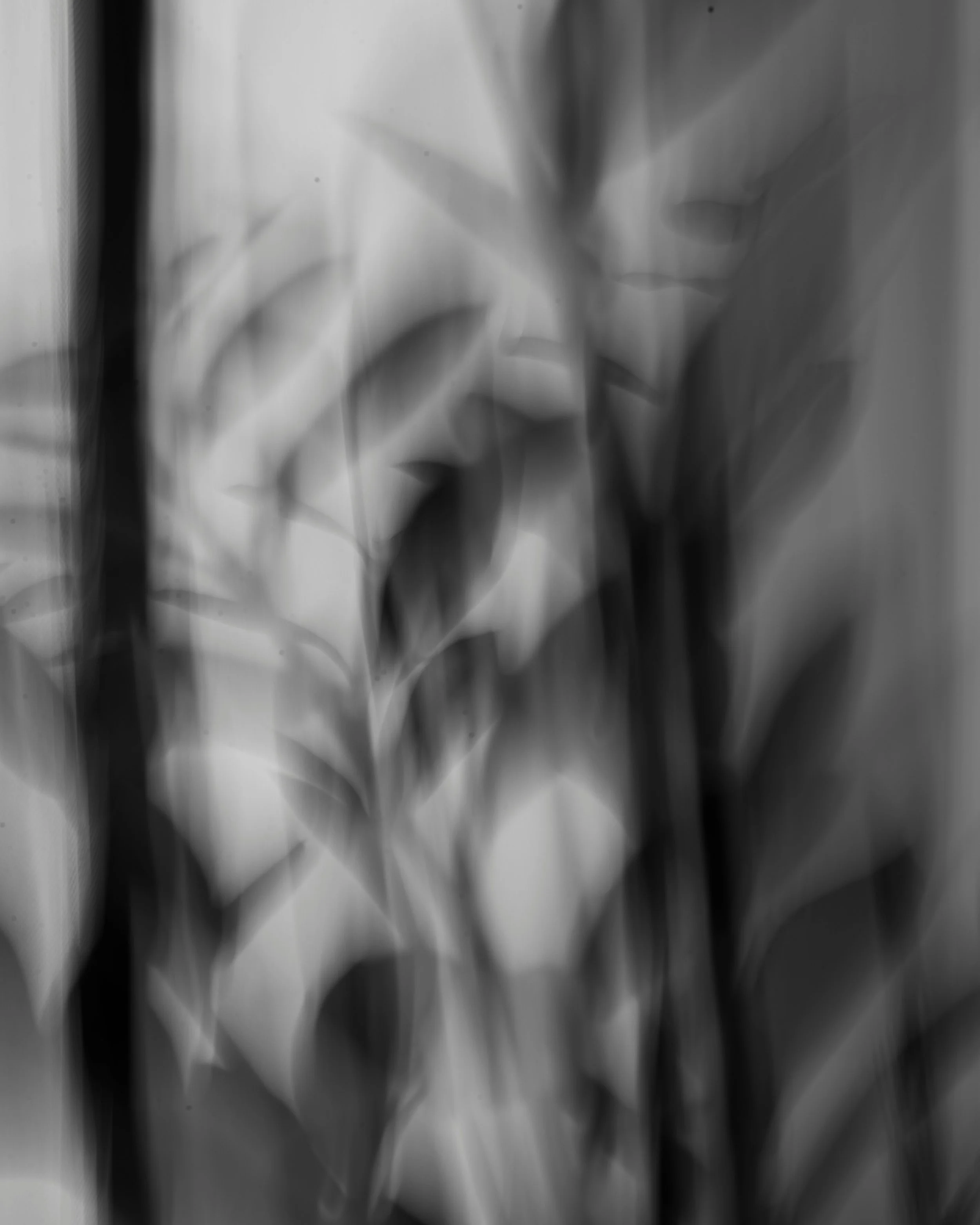
Juli Kosolapova, grayscale, digital photograph, 2021. Courtesy of the artist.
All That Distance,
Still Arriving
ARya Samuelson | June 2026 | Issue 52
FICTION
We are in bed at four in the afternoon: me, Hannah, and her dog Polly. I am so in love with Hannah that it hurts — hurts that I cannot feel Hannah’s skin because her dog has draped herself onto Hannah’s body, barricading the two of us, but even more than that, it hurts that Hannah is actually trying to sleep right now, which is the last thing that I feel like doing. To ward against further hurts, I sit propped up against pillows, poised with my magazine and read. I laugh, both because it’s occasionally funny, and also because I’m hoping that Hannah will wake up and want to know why. “Shhhh,” she rebukes me.
Earlier that day Hannah and I were at the botanic garden, surrounded by the fanned spikes of the coccothrinex crinita, the seaweed fingers of phoenix roebelani, huge hovering banana plants. My lips grazed Hannah’s papery blouse as we sat together on the bench, marijuana from the vape in Hannah’s pocket humming inside us as if she could recognize her fellow plant comrades from dreams. We sat quietly for a long time, surrounded by that family of green, its happy hunger.
Quiet except when I worried that Hannah might be getting bored, so I commanded her eyesight towards something that would keep her here with me. Quiet except when Hannah noticed something far more interesting, something I’d completely missed, like how the undersides of the banana leaves were printed with facts about colonization and faceless corporations, and I wished I could borrow her painter’s eyes — astute, always wide-open — to see the world like she does, not only because it would turn my world less myopic, but also because then I would never have to worry about what she was actually looking at, what she was actually thinking, and maybe then I would finally stop worrying about whether she was going to leave me.
“Do you think there’s life on other planets?” I asked. This was another habit of mine: to present a non-sequitur, the first one I could think of, anything to keep the conversation going.
She frowned, surprised. “I guess that’s a choice, isn’t it?”
“What do you mean?”
“Well, scientists don’t seem to be able to find any trace of sentient beings, but it seems crazy to imagine that we’re really the only ones out there. Just because they can’t find anything doesn’t mean it doesn’t exist. So, I think the choice might be up to us. Do you want to believe that we’re alone here?”
This afternoon at the garden was the first time in weeks that I’d felt close to Hannah. We’ve been together for almost a year, but lately, I’ve detected distance creeping in, an accumulation of tiny moments that set off my radar for looming disaster. Little things, like how it can take her hours to respond to a text message or her requests for more alone time on the weekends. She says these are just signs of her getting more comfortable in the relationship, asking more for what she really needs, but I don’t know what to trust — her words, or the familiar web of terror spinning in my gut. Like, for instance, why — after my question about extraterrestrial life forms — had Hannah announced so abruptly that she was tired, and risen so suddenly, pushing us like a gust of wind out of the garden, up the hill, and back to her house? She said that it didn’t have anything to do with what I’d said or done, but what else could account for such a sudden urge not only to leave our lovely afternoon, but to sleep — the one place we couldn’t go together?
In bed, I console myself with the feast of the magazine until its glut makes me not quite drowsy, but too full for more. I curl myself against Polly’s furred spine and shroud my eyes in the comforter to block out the sun. I am positive I am not sleeping, but when I rouse, deep blue has settled like mud at our windows, the beautiful day having finally abandoned us. Polly whimpers for dinner time, faintly but unmissably, and Hannah hops out of bed to feed her. They scurry off, and I am relieved that Hannah is now awake and can’t blame it on me.
“Hey,” she says, climbing back into bed after Polly has been fed, turning on her side to face me. These are the moments that I don’t know how to write about sans clichés. How I see forever in her eyes. Their openness and sparkle. When I look at her, I understand why men throughout history have demanded a woman’s head to guide their ship. How the awe commanded by Helen of Troy’s beauty could have started a war.
Hannah curls into me, signaling without words the intention to return to her nap, and I am suspended between the blooming warmth of her body and the crane of my neck in a position that cannot be sustained.
I am trying to figure out whether to voice my inner freakout when Hannah taps on my knuckles, almost imperceptibly. I nod back with the pulse of my hand. We speak back to each other like this for a while, or am I imagining it? The way her elbow just squeezed into my hip for the briefest second. Frisson of thumbs. My lips against her eyebrows. To say I am kissing them would be melodrama. Would break the game — the game I am not sure we are even playing.
Even more than a game, it feels like a duet, an improvisation. Your turn now. I am not sure whether her responses are deliberate, or the twitches of near-sleep, but I am riveted, wildly alive. I feel like the cosmos, aware of every shooting star.
These are the moments that I can’t help but turn into metaphors. The places so deep inside they can only be touched through image, abstraction, through something they are not. But also because I am not supposed to tell you where I am having this feeling, and even if I did, the words I’d use would flatten, mock my own truth.
To be in bed with the woman you love at five in the afternoon, five-thirty, six. To become the Milky Way, shuddering, smeared with stars. Contained, yet always expanding. Are there sounds in outer space? Because if I were to make a single sound right now, I fear everything would burst. Big Bang a new disastrous planet.
Compared to the cosmos, sex would be such a cheapened act, like trying to put a costume on God. I don’t want — I don’t need — anything else to happen besides our bodies together, exactly like this. I am completely, utterly, perfectly content —
— Until my thoughts turn on. I mean —
Who said the Big Bang could only create disaster? What if it created the kind of planet scientists are only searching for, but whose rational methods and objective scrutiny will never reveal — the kind of planet that is bountiful, oxygenated, teaming with possibilities for new life? And what if Hannah is here, right just this moment, thinking the very same thing? What if this is the opportunity for reconnection that we’ve been needing all along? To let all the words fall away and trust the urges of our bodies to collide us back together.
As Hannah blinks her eyes open, I try to make a story out of their light. But it’s like projecting story onto constellations. It doesn’t make them true.
So I open my throat and dare to ask:
“What do you want right now?”
It’s not the right question, and I know it by the way my voice falters. Thin like a child’s, measuring her mother’s moods.
I know it because Hannah hesitates. I don’t know what she’ll say, but whatever it will be, I am already humiliated. My desire like a fart exploding beneath the covers.
I am not used to being rejected in this way. With my earlier male partners, I’d always felt like
their inner world was just out of reach, but desire was a thread, a rope, that would always lead them back when they drifted too far. That would give me — almost — nearly — the closeness I craved. But Hannah won’t let me hide behind sex as a crutch for connection, and sometimes I hate her for this.
“Can we just stay like this? Just as we are?” Hannah asks, kneading my shoulder. She is squeezing out a smile. Her eyes are too kind.
Steady star.
But isn’t everything we perceive in the night sky an outdated map? All that distance, still arriving. I wonder if, when I look at Hannah, I am watching a star that has already died — perhaps even thousands of years ago — and the news just hasn’t reached me yet.
Do you want to believe we’re alone here? She asked me earlier, and I wonder if maybe I do. Maybe it’s easier that way.
She reaches for my hand, as if she is one of the plants from the garden this afternoon, its vines wrapping around my own, or edging its leaves a micro-inch closer to the sun. But all I feel is rejected. She has tanked my spaceship, sent me flinging in the wrong direction of the cosmos. Or maybe it is me who created this distance in the first place, yanking us all the way to outer space and now unwilling to come back.
She squeezes me, and I can tell that she means it, that she is happy here, but I’m not. We are hovering too close to earth, too close to all my other concerns. I miss the feeling of having left them all behind.
Soon, I’ll announce that I’m hungry, and we’ll make dinner without saying much. I’ll go home and sleep in my own bed, which I’ve never been the one to suggest before, which I didn’t know that I could want. At home, sleep will still refuse me, the memory of Hannah’s warmth taunting me. Remembering how alone I felt even then. Remembering her question, the choice she posed, as if such a decision could really be up to me, this body unable to trust gravity on this spinning planet. As if I could have the power to make a different choice, and it would make a difference. As if I could feel powerful enough to ask: if we’re not alone, what might we be instead?
Arya Samuelson is a writer, editor, educator, and somatic practitioner in Western Massachusetts. She is the winner of New Ohio Review’s Nonfiction Prize, Lascaux Review’s Nonfiction Prize, and CutBank’s Montana Prize in Nonfiction awarded by Cheryl Strayed. Her essay, “I Am No Beekeeper” was selected as Notable in Best American Essays 2024. Other essays and stories have been published in Fourth Genre, Bellevue Literary Review, Columbia Journal, Gertrude, and elsewhere. Arya holds an MFA in Creative Writing from Mills College, and her work has received support from Marble House, Ragdale, Monson Arts, Mass Cultural Council, Edith Wharton/Straw Dog Guild, Virginia Creative Colony for the Arts, Vermont Studio Center, and Juniper Summer Writing Institute. Arya teaches and works as a developmental editor and creative coach to help writers unearth the deeper story. She is currently writing a memoir, a novel, and a book of essays.