Holding Hands: Three Essays
by Ed Wolf
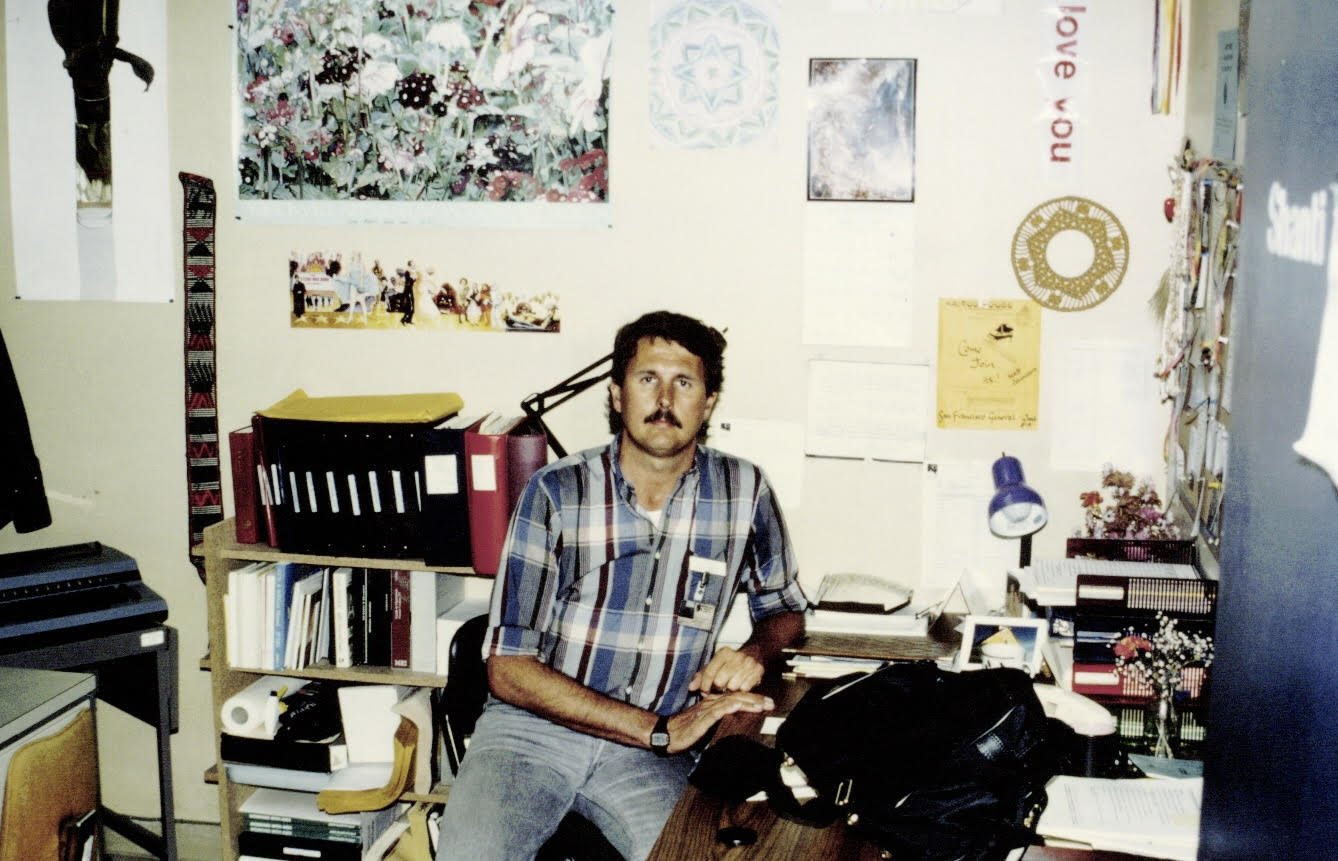
On the AIDS Ward at San Francisco General Hospital, 1987. Courtesy of the author.
Holding Hands:
Three Essays
Ed Wolf | June 2026 | Issue 52
Essay
Dynasty
I worked in the typesetting division of George Litho with seven other gay men when I began the Shanti AIDS Volunteer Training in San Francisco in 1983. Ron was one of the department’s proofreaders, and we’d gone to dinner a few times, went to the movies, once rode bikes the entire length of Golden Gate Park, all the way out to Ocean Beach. He came from a small town in the Midwest and had a biting sense of humor that was really fun and I enjoyed doing things with him.
Ron lived in a great apartment overlooking the Panhandle of the park, and he invited me over to have dinner with some of his friends to watch Dynasty. He’d memorized all the nasty things Alexis and Krystal had ever said to one another, and was always looking forward to their next catfight. I was surprised, when I arrived, to find the table set for only the two of us, and he said something about his friends having to cancel. He was an excellent cook and had me in stitches as he described what he’d gone through buying the chicken we were eating.
When it was time for Dynasty to start, we moved into the living room. I sat on one end of the couch and he the other. Alexis and Krystal were in rare form, threatening each other like tacky drag queens, and I laughed as Ron repeated every word and gesture. He got up during the commercial break, came back with a plate of cookies and, sitting down next to me, handed me one of his homemade snickerdoodles. Dynasty returned and as we were watching, Ron moved closer to me until his leg pressed up against mine. He held up the plate of cookies, asking if I’d like another, and as I reached for it, leaned in to kiss me. I pulled back and he said sorry and I said it was fine and he said he was lonely and then laid his head on my shoulder.
I liked Ron, thought he was funny and interesting, but wasn’t drawn to him sexually. When he asked me to hold him, I put my arm awkwardly around his shoulders, and he laid back against me and then slowly undid his belt and pulled his pants and underwear down. His dick was already hard, and he stared at me intensely as he held it and began to masturbate. I was very uncomfortable and it was all happening so quickly, I wasn’t sure what to do. He began to groan and stretched his legs out and came on his belly and I looked down and saw three dark purple splotches on his thigh. Having been through the first weekend of the Shanti training, I knew they were KS lesions.
We sat there, he slumped against me as his cum slowly dried. The virus was right there, laying on his soft white belly, as Alexis said something bitchy to Krystal.
+
The Duty to Live
It was a very busy morning on the AIDS ward and I went back and forth from a patient’s room as he did his work, which is what it was, working to breathe. His mother was alarmed as he repeatedly gasped for air and she called for the nurse who added another dose of morphine to his central line. The father sat near the window, on the edge of his chair, ready, it seemed, to fly away if there were any sudden movements.
Their son had been on the unit for ten days now, hoping he would get better, and not have to call them. He didn’t want to put them through any of this, especially his father, who had just arrived from the airport, wearing Bermuda shorts and a Hawaiian shirt. A camera hung around his neck and I guess he was a tourist of sorts, here in this foreign land, where people who were dying were “doing their work,” and the people who cared for them were all queer. The mom had been here a week already and was counting the seconds of silence between her son’s gulps for air, as if trying to figure out how far away the lightning was.
Slowly his machinery slowed, slowly his breaths became so faint until something began to gather in the corners of the room, something I’d felt before. It filled the corners and the walls themselves had a sheen and the ceiling softened like cloth, and the father got up and opened the drapes as far as he could and tried to open the windows, but they didn't. The father made a sound like the word “freedom,” and then his boy’s fine inner workings—his lungs, heart, eyes—all stopped. The mother lifted her head and looked up, as if watching something hovering above the bed, and I thought I could feel it too, a draft through a great crack in a wall, and as he went through it seemed like she wanted to go with him, or could hear him calling, “Come with me, come with me, come with me,” until he was gone. And what more then, what more could she have done, having done this, the hardest thing, to hold him as he was leaving.
And now he was gone. The great crack in the wall had closed, but the room was full of sunshine, and as their son’s skin grew cold and his fluids settled, we all still had breath and warmth, and all that had been left behind was our duty to live.
+
Holding Hands
Larry was taking his time to die. His sister and father, who had dutifully stayed by his bedside on the AIDS unit for two weeks, needed to return to Missouri. His dad had to get back to work and his sister had young children waiting for her to come home. They left tearfully, feeling terrible that Larry was going to die alone. One of the night nurses, who’d been with a lot of dying people, had pulled them aside and explained that actually, it was often easier for some patients to let go when there weren’t family members camped out around their bed. I don’t know if the sister actually believed that, but she seemed to appreciate the nurse’s intention.
Because I was one of the Shanti counselors on the unit, I would go in and sit with Larry when I had the time. He’d lost consciousness the week before, but I’d been told, from other patients who’d come back from being in a coma, that they’d heard everything that had been said when they were seemingly out of it, so I’d sit with him and explain why his dad and sister had to leave and how we were there for him.
While I was holding his hand one morning I looked down and saw that the fingernails on his right hand were filthy. I filled a pan with warm water and used a small brush to clean them. Later that day, when I returned to sit with him again, I took his hand in mine and saw that his fingernails looked like he’d been scratching and gotten blood or dead skin under them, even though there were no obvious marks on his face or body. I refilled the pan with warm water and used the small brush to clean his hand once more.
The following day, when I came in to see him, his fingernails were dirty again. It looked as though he’d been working in a garden, digging deep into the ground. I found the pan and brush and cleaned his hand a third time.
“What is it?” I whispered into his ear. “Do you need something?”
There was no reply, of course, and when I saw his nurse and told her about it, she shrugged.
“Who knows,” she said.
Larry continued breathing. His sister called each day, and I’d hold the phone up to his ear so she could say she loved him, and every time I looked down there was something dark under his fingernails and no matter how often I cleaned them, the dirt or blood or dead skin or whatever it was would return.
On the day he died, I stopped trying to clean his hand, but simply held it mine.
Ed Wolf was born in New York, the oldest of ten children, and grew up in North Miami Florida. He worked in the HIV/AIDS field from 1983 to 2022, and is featured in the award-winning documentary “We Were Here.” He is currently at work on a memoir, which tells the story of growing up as a queer kid in Florida, attending the University of South Florida in the late 60s, life in New York’s Greenwich Village at the beginning of gay liberation, and the early days of the AIDS epidemic in San Francisco. He has written numerous segments of his memoir during Corporeal Writing’s virtual hours and is very grateful for everyone who keeps that program alive and well!